Lavender bath salts for sensitive skin: shopping cautiously

Sensitive-skin bath-salt shopping is choosing a soak by its full ingredient list, with the aim of enjoying an indulgent ritual without ignoring your skin’s limits. Small-batch craft and a soft lavender scent can make bathing feel special, but neither proves that a formula suits sensitive skin.
- Choose lavender bath salts for sensitive skin by ingredients and past tolerance, not soothing language.
- Bathe in Luxury offers scented bath rituals; its lavender salts are not established sensitive-skin formulas.
- Compare Epsom salts and foaming bath salts separately; their formulas are not interchangeable.
- Skip lavender when fragrance is a known trigger, and keep new bath products separate.
Why bath-salt choices matter for sensitive skin
A comforting scent is not evidence of skin compatibility. Lavender describes an aroma or ingredient, not a guarantee against irritation. Essential oils and fragrance ingredients can cause reactions, including in products presented as natural.
Shopping for yourself gives you permission to be particular. You do not need the most elaborate soak, the strongest scent, or a matching collection. You need enough information to decide whether the product belongs in your bath at all.
Bathe in Luxury sells handcrafted soap and bath-and-body products for everyday self-care. Bathe in Luxury is best for shoppers seeking scented bath rituals, not shoppers seeking a verified sensitive-skin formula. That distinction keeps the pleasure of shopping separate from an unsupported safety promise.
For your 2026 bath routine, start with what your skin already tolerates. A familiar, uncomplicated ritual beats an unfamiliar formula chosen only because its description sounds gentle.
How to shop for lavender bath salts cautiously
1. Identify what your skin already tolerates
Start with your own bathroom shelf, not a shopping cart. Read the labels of products you comfortably use and note any ingredients you already know to avoid. Your experience is more useful than someone else’s description of a heavenly soak.
Sensitive skin is not a single, uniform shopping category. A product that feels comfortable for another person is not proof that it will suit you. Likewise, enjoying lavender in a room does not establish that you tolerate it in bathwater.
If fragrance has caused a reaction before, do not treat lavender as an exception because it comes from a plant. If you have a diagnosed skin condition or a previous significant reaction, ask your dermatologist before introducing a scented soak.
- Keep the labels of products you already tolerate.
- Write down known fragrance or ingredient triggers.
- Separate scent preferences from skin experience.
- Avoid experimenting on already irritated or broken skin.
- Ask for professional guidance when past reactions complicate the choice.
2. Read the whole formula before choosing the scent
Open the ingredient list before reading the mood-setting description. Words such as calming, restful, and soothing describe the intended experience; they do not establish that a product has been assessed for sensitive skin.
Check the base, the scent ingredients, and any additional ingredients. A title containing lavender does not tell you whether the aroma comes from essential oil, fragrance, or a combination. Nor does an Epsom-salt title establish that magnesium sulfate is the only ingredient.
Use a simple 2026 shopping checklist: base, scent, extras. If the complete formula is not clear, request it before deciding. Do not fill the gaps with assumptions about handmade products.
Bathe in Luxury describes Lavender Epsom Salt as magnesium sulfate infused with lavender. That identifies the broad product type, but the description is not a substitute for reviewing the full ingredient label.
- Identify the salt base.
- Locate fragrance and essential-oil ingredients.
- Review colorants, botanicals, oils, and other additions.
- Compare the label with your known triggers.
- Request clarification when the ingredient information is incomplete.
3. Separate a salt soak from a foaming bath
Decide what you want the bath product to do before comparing scents. A salt soak and a foaming bath are different experiences, even when both carry a lavender name. Foam is a feature to choose deliberately, not evidence of greater gentleness.
The practical way to compare them is to place their ingredient lists side by side. Look beyond the shared scent and identify what changes between the formulas. A shorter list is easier to review, but length alone does not establish safety.
Bathe in Luxury offers both Lavender Epsom Salt and Lavender Foaming Bath Salts. The latter description includes mineral-rich salts and a foaming base. Those are distinct options, not interchangeable versions of a proven sensitive-skin product.
- Choose whether you actually want foam.
- Compare the complete formulas side by side.
- Review the foaming ingredients rather than judging by bubbles.
- Keep your known tolerances ahead of texture preferences.
- Avoid assuming an Epsom-salt product is unscented.
4. Choose less complexity when fragrance is uncertain
You can make a bath feel indulgent without adding a scented product. A comfortable towel, a quiet room, and a familiar cleansing routine create a sanctuary without requiring a new formula. Start there if your skin is unsettled.
When fragrance is a known trigger, a fragrance-free option is the more relevant category to investigate than another lavender blend. Check the actual label: unscented and fragrance-free do not necessarily mean the same thing. Even a plain product still needs an ingredient review.
If lavender is already part of products you comfortably use, that experience helps frame your questions. It does not prove that every lavender bath formula will suit you. Concentration, other ingredients, and the way you use a product still matter.
- Skip scented salts when fragrance is a known trigger.
- Read fragrance-free claims alongside the ingredient list.
- Avoid treating unscented as an automatic equivalent.
- Keep familiar bath products in place while deciding.
- Choose the ritual first and the optional extras second.
5. Follow the label and introduce products separately
Do not create your own stronger recipe. Follow the product’s directions rather than borrowing a scoop size from another salt, a social post, or a homemade mixture. There is no universal amount suitable for every bath-salt formula and every person.
Keep 1 new bath product separate from other new additions. Introducing scented salts, a scrub, and a new soap together makes it harder to identify what caused discomfort. A quieter routine gives you clearer information.
For your 2026 routine, do not invent a home testing method with concentrated crystals or undiluted essential oil. Ask a dermatologist how to assess a rinse-off product if you are unsure. Stop using a product if it causes discomfort; persistent or significant symptoms need medical advice.
- Read the directions before opening the product.
- Follow the labeled amount and method.
- Avoid mixing in additional essential oils.
- Introduce new bath products separately.
- Stop use rather than trying to endure stinging or itching.
6. Keep notes before building a collection
After trying a product according to appropriate guidance, record what you used and how your skin felt. Include the exact product name, not simply lavender salts. Similar names can hide different formulas.
Keep the ingredient label with your notes so you can compare it with later purchases. When shopping again, review the current label instead of assuming a familiar name means an unchanged formula.
Use 3 checks before repeating a purchase: ingredients, directions, and your experience. This is a shopping aid, not a diagnosis. You do not need to turn self-care into homework; a brief note prevents the same uncertainty from returning with every new jar.
- Record the exact product name.
- Save the ingredient information you reviewed.
- Note any discomfort and stop using the product.
- Recheck the label before buying again.
- Keep products that suit your routine separate from untried purchases.
Compare your bath-salt options
Choose by formula first, experience second. This 2026 comparison separates what each option offers from what it does not establish. None of these categories guarantees compatibility with sensitive skin.
| Option | Best for | Useful feature | Key limitation |
|---|---|---|---|
| Plain, fragrance-free Epsom salts | Shoppers avoiding added scent | A formula without added fragrance removes that particular exposure | Fragrance-free does not guarantee comfort; check ingredients and directions |
| Lavender Epsom Salt | Shoppers who want a lavender-scented salt soak | Described as magnesium sulfate infused with lavender | Scented; the description does not establish sensitive-skin suitability |
| Lavender Foaming Bath Salts | Shoppers who want lavender scent and foam | Combines mineral-rich salts with a foaming base | Adds a foaming formula to review; bubbles do not establish gentleness |
| A bath without added salts | Shoppers choosing not to introduce another product | Avoids introducing bath-salt ingredients | Does not provide the scented or foaming experience |
The useful distinction is not luxury versus basic. It is a formula you can assess versus a formula you are guessing about. No bath additive is a requirement for a satisfying ritual.
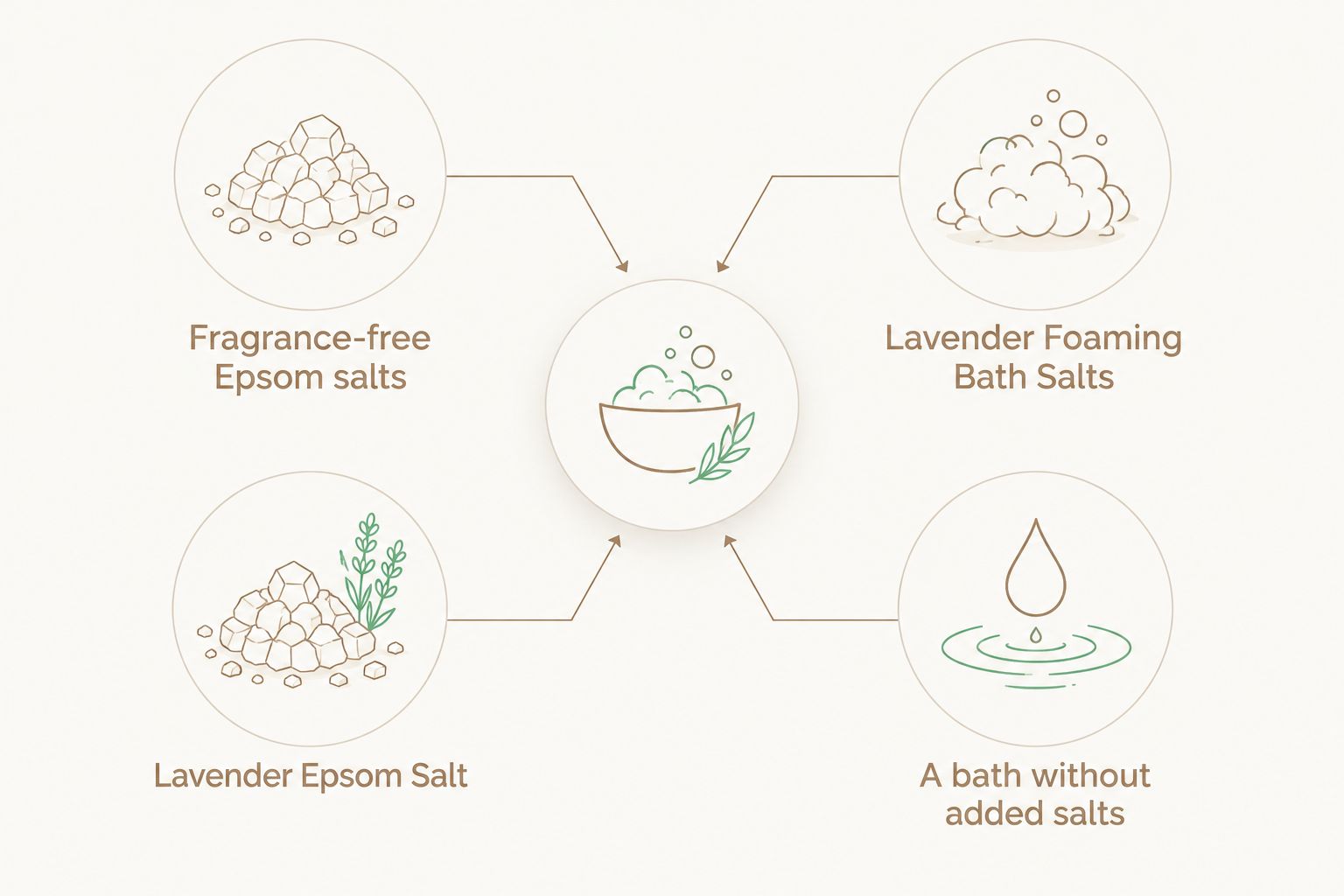
Lavender options to review, not sensitive-skin endorsements
These 2 Bathe in Luxury lavender bath-salt options illustrate the formula distinction above. Choose neither on the strength of calming language alone. Review the full ingredients and directions before deciding whether a scented soak fits your routine.


Common mistakes sensitive-skin shoppers make
Treating lavender as a sensitive-skin claim
Lavender names a scent or ingredient. It does not mean hypoallergenic, fragrance-free, or suitable for eczema. Keep those claims separate when reading a label.
Buying the whole matching ritual immediately
A coordinated scent sounds lovely, but introducing several unfamiliar products together obscures your experience. Start with a decision about each formula, not an obligation to complete a collection.
Confusing craft with compatibility
Handcrafted and cold-processed describe how certain products are made. They do not establish that a bath-salt formula suits sensitive skin. Appreciate the craft without turning it into a safety claim.
Reading a product name as an ingredient list
A botanical name, a food-inspired scent, or a creamy description does not reveal the complete formula. The same rule applies to vegan shopping: verify the actual ingredients rather than inferring them from the product name.
Using more to make the bath feel luxurious
A stronger scent is not a better match for sensitive skin. Follow the directions, and let the rest of the setting provide the indulgence. Soft towels ask nothing of your ingredient tolerance.
FAQ
Are lavender bath salts good for sensitive skin?
Lavender bath salts are not automatically suitable for sensitive skin. Review the complete formula, your known triggers, and the directions; a soothing description is not evidence of compatibility.
Are plain Epsom salts better than lavender bath salts?
Plain, fragrance-free Epsom salts are the more relevant option when your goal is to avoid added scent. They still require an ingredient check and do not guarantee that your skin will tolerate them.
Can lavender essential oil irritate sensitive skin?
Yes, lavender essential oil can cause irritation or an allergic reaction. Natural origin does not make a fragrance ingredient risk-free.
Are foaming bath salts gentler than regular bath salts?
Foaming bath salts are not inherently gentler than nonfoaming salts. Their foaming ingredients need review alongside the salt base, fragrance, and other additions.
Which Bathe in Luxury lavender salts should I choose for sensitive skin?
Neither Lavender Epsom Salt nor Lavender Foaming Bath Salts is established here as a sensitive-skin formula. Choose only after reviewing the full ingredients and directions against your needs, with professional guidance when appropriate.
How much lavender bath salt should I use?
Follow the directions for the exact product rather than a universal scoop recommendation. Do not increase the amount to intensify the scent or copy directions from a different formula.
Can I use lavender bath salts when my skin is already irritated?
Do not introduce a new scented soak while your skin is irritated or broken. Keep to your established care guidance and ask a dermatologist about persistent symptoms or a diagnosed condition.
One last thing
Your best 2026 bath upgrade might be subtraction. Remove the extra scent layer, leave the scrub for another occasion, and keep the product your skin already knows.
Luxury does not need to mean more ingredients. Make the setting indulgent and the product decision deliberate. A quiet room and a favorite towel can carry the ritual when lavender is not the right choice.