How to read luxury soap ingredients before you buy

Read luxury soap ingredients by separating the cleansing base from scent, color, and added texture, then checking anything you personally avoid. Handcrafted, cold-processed soap brings craft to your daily ritual, but those words do not replace an ingredient list. For your 2026 purchase, choose the bar whose formula and scent suit you—not the one with the longest list of promises.
- Luxury soap ingredients matter more than luxury wording: check the cleansing base, fragrance, and ingredients you avoid.
- Batheinluxury is best for shoppers seeking handcrafted, cold-processed soap for an everyday bath ritual.
- A scent name does not prove that a soap contains the plant, food, or essential oil it references.
- Verify vegan claims for each individual bar; handmade and plant-scented do not establish ingredient origin.
Why this matters
A beautiful bar can make an ordinary shower feel considered. But your favorite scent and your ingredient requirements are separate buying decisions. Read both before you commit.
Batheinluxury sells handcrafted, cold-processed soap and bath products. Choose luxury soap for the ritual, then check the individual formula for your requirements. Neither a collection name nor a craft description tells you everything inside a particular bar.
How do you read luxury soap ingredients before you buy?
Use the same sequence for every bar. Start with what cleans, move to what scents it, and finish with the ingredients that matter to your preferences or known sensitivities.
- Find the complete ingredient declaration. Look beyond the front label and highlighted ingredients. A short description featuring one oil is not necessarily the whole formula.
- Identify the cleansing base. Look for oils and an alkali, names of saponified oils, or other cleansing ingredients. Different naming styles can describe different stages of soapmaking.
- Find the scent ingredients. Look for fragrance, parfum, or specifically named essential oils. Do not treat the product's scent name as its ingredient declaration.
- Check additions separately. Oats, botanicals, clays, colorants, and other additions have distinct roles. Their presence does not establish a medical benefit.
- Check your exclusions. Review animal-derived ingredients, particular fragrances, or anything you already know you need to avoid.
- Resolve uncertainty before buying. Ask the seller about an unclear ingredient or source rather than filling the gap yourself.
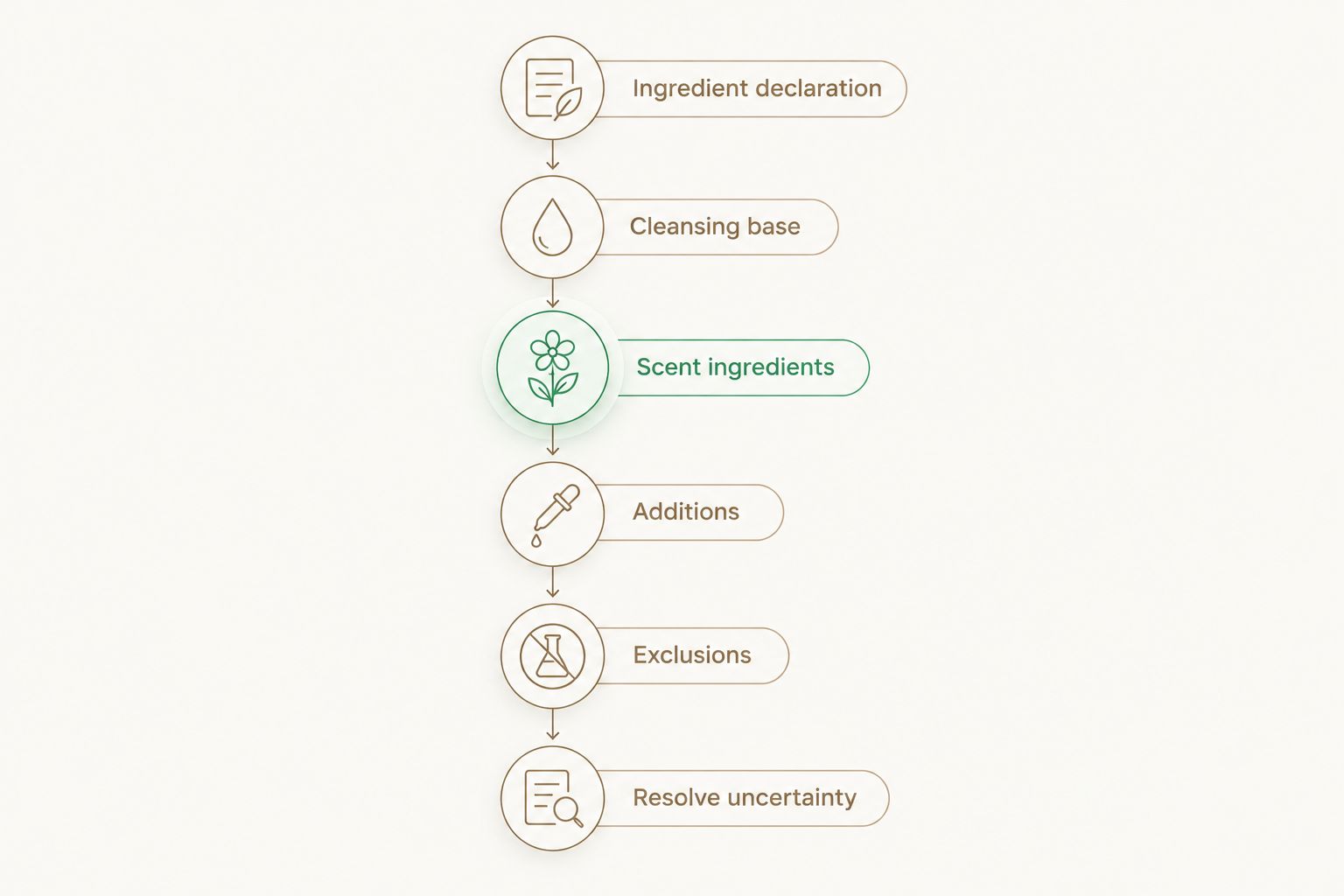
You do not need to memorize every ingredient name. You need to recognize its role and know when the label leaves a question unanswered. That makes the next bar easier to choose, too.
Cleansing base: understand what the names describe
Traditional soap forms when fats or oils react with an alkali through saponification. A finished ingredient declaration can describe the starting materials or identify the resulting soap ingredients. That distinction explains why two labels can look unfamiliar in different ways.
For example, sodium olivate is the sodium salt of fatty acids derived from olive oil; sodium cocoate refers to soap derived from coconut oil. These are general ingredient examples, not statements about any particular bar sold here.
| Label wording | What it tells you | Useful for | What it does not establish |
|---|---|---|---|
| Oils plus sodium hydroxide | Names materials used in making bar soap | Understanding the starting formula | How the finished bar feels on your skin |
| Saponified oils | Describes oils that have undergone soapmaking | Recognizing a soap base | Exact proportions unless separately disclosed |
| Sodium olivate or sodium cocoate | Names resulting soap ingredients | Identifying the source of those soap ingredients | That the entire formula contains only those ingredients |
| Other cleansing ingredients | Indicates cleansers beyond, or instead of, traditional soap | Comparing different cleansing formulas | Whether the finished product suits your preferences |
An unfamiliar name is a reason to identify an ingredient, not automatically reject it. Likewise, a familiar kitchen ingredient is not proof that a finished cleansing product will suit everyone.
Does sodium hydroxide mean the finished bar is harsh?
Sodium hydroxide is used to make traditional solid soap. Its appearance in a starting-material ingredient declaration does not, by itself, establish that the finished bar contains unreacted lye.
A label alone also cannot prove that a batch was formulated or made correctly. Do not turn one ingredient name into either a safety warning or a quality guarantee.
Fragrance: choose the scent without guessing the formula
Scent is part of the pleasure. The practical question is whether the scent ingredients fit what you want to use every day.
Fragrance or parfum can represent a fragrance mixture rather than a list of each scent component. A specifically named essential oil identifies that ingredient more directly, but it does not make the finished bar automatically suitable for sensitive skin.
| Scent approach | Best for | Advantage | Limitation |
|---|---|---|---|
| Fragrance or parfum | Shoppers comfortable with a fragrance mixture | Supports a wide range of scent compositions | The label does not necessarily identify every component |
| Named essential oils | Shoppers checking for particular plant oils | Makes those named oils identifiable | Essential oils can still cause irritation or allergic reactions |
| Fragrance-free formula | Shoppers deliberately avoiding added fragrance | Removes added fragrance from the buying brief | Other ingredients still need checking |
The FDA distinguishes fragrance-free from unscented: an unscented product can contain fragrance used to mask another odor. If avoiding fragrance matters to you, check the declaration rather than relying on how quiet the scent sounds.
For a 2026 soap purchase, keep the order simple: exclusions first, scent preference second. You can enjoy a beautifully scented ritual without treating natural fragrance as a safety certificate.
Can you trust a scent name as an ingredient list?
No. A scent name describes the experience being offered, not necessarily the materials used to create it. Food-inspired and botanical names deserve the same careful reading.
For example, the name Peppermint Soap Bar identifies a scent-led product to investigate. It does not, on its own, establish whether the formula contains peppermint essential oil, another fragrance source, or a particular amount of either. Check the current declaration before choosing it for an ingredient requirement.
Vegan ingredients: verify the individual bar
Handcrafted does not mean vegan. Neither does botanical packaging or a plant-inspired name. Vegan shopping requires checking the particular product, including ingredients whose sources are unclear.
Honey, beeswax, milk, and tallow are animal-derived ingredients. Glycerin can come from different sources, so its name alone does not confirm whether it meets a vegan requirement. Ask about sourcing when the ingredient declaration does not settle the question.
For Batheinluxury soap, make that decision bar by bar. A store-level description should not replace product-level ingredient evidence, and one confirmed formula does not establish the composition of another.
Vegan and cruelty-free also answer different questions. Vegan concerns animal-derived ingredients; cruelty-free concerns animal testing claims. Do not use either term as a substitute for the other.
Why luxury soap ingredient lists vary
There is no single formula that every luxury bar must follow. Compare what the differences mean for your purchase rather than ranking labels by how impressive they sound.
- Cleansing formula. Different oils and cleansing ingredients create different formulations. The ingredient names identify materials, not a universal quality ranking.
- Scent choice. A fragrance mixture, named essential oils, or no added fragrance changes what you need to check.
- Added texture. Particles and botanical additions deserve attention if you prefer a smooth bar. Read how the maker describes their role rather than assuming gentle exfoliation.
- Color choices. Colorants change appearance. A dramatic swirl does not establish a cleansing or skincare advantage.
- Declaration style. Starting-material names and resulting soap names can make labels look different even before you compare their formulas.
- Product claims. In the United States, a product's composition and intended use affect how it is regulated. Not every cleansing bar follows the same labeling framework.
A longer declaration is not automatically worse, and a shorter declaration is not automatically better. Compare the ingredients against your actual requirements, not an arbitrary ingredient count.
What ingredient order can—and cannot—tell you
For U.S. cosmetics, FDA ingredient-labeling rules generally require ingredients in descending order of predominance, with exceptions. Ingredients present at 1% or less can appear in any order after ingredients present above 1%; color additives have separate ordering provisions.
That makes ingredient order useful, but not a recipe. You cannot calculate a formula's exact percentages from its label, and the last few entries do not necessarily descend neatly by amount.
There is another important distinction for your 2026 label check: products meeting the federal definition of soap and marketed only as soap are regulated differently from cosmetics. The FDA's Frequently Asked Questions on Soap explains that distinction; its Cosmetic Labeling Guide explains cosmetic ingredient declarations. These are U.S. regulatory references, not quality ratings for individual bars.
If the complete declaration is difficult to find, ask for it. Do not assume that a short product description lists everything simply because it mentions attractive ingredients.
Does cold-processed mean the ingredients are better?
Cold-processed describes a soapmaking method, not an ingredient quality score. It gives you useful craft context, but it does not establish a vegan formula, a particular scent source, or suitability for sensitive skin.
Enjoy the craft without asking the phrase to do more than it can. In 2026, the sound buying rule remains straightforward: read the method for context and the ingredient declaration for composition.
Are natural soap ingredients always gentler?
Natural ingredients are not automatically gentler. Plant-derived ingredients, including essential oils, can cause unwanted reactions, and the word natural does not establish how a complete formula will feel on your skin.
If you already know an ingredient causes a problem for you, avoid it regardless of its origin. If you need help identifying a recurring reaction, seek advice from a qualified healthcare professional rather than treating a luxury soap description as a diagnosis.
What should you ask before buying an unclear formula?
Ask for the complete ingredient declaration and clarification of the specific ingredient or claim that matters to you. A focused question is more useful than asking whether a bar is simply clean or chemical-free.
Try: Does this formula contain added fragrance? Is this glycerin plant-derived? Does this bar contain milk, honey, beeswax, or another animal-derived ingredient? Keep the question tied to your purchase decision.
FAQ
What should I look for first in luxury soap ingredients?
Look for the complete ingredient declaration first, then identify the cleansing base, scent ingredients, and anything you avoid. Highlighted oils or a scent description do not necessarily represent the whole formula.
Does a luxury soap need a short ingredient list?
No, a short ingredient list does not establish that a luxury soap is better. Choose according to the formula's contents and your requirements, not an arbitrary ingredient count.
Is soap made with essential oils always better than fragrance soap?
No, essential oils are not automatically better or gentler than fragrance mixtures. Check the specific ingredients and avoid known triggers rather than choosing by natural wording alone.
Does glycerin mean a soap is vegan?
No, glycerin alone does not establish that a soap is vegan. Its source can vary, and the rest of the formula must also be checked for animal-derived ingredients.
Can ingredient order tell me exactly how much oil a soap contains?
No, ingredient order does not disclose exact percentages. U.S. cosmetic labeling rules also allow ingredients at 1% or less to appear in any order after ingredients present above 1%.
Are all Batheinluxury soap bars vegan?
Verify vegan status for each Batheinluxury soap bar using its individual ingredient information. Do not extend a claim from one product or a store description to every formula.
What is the best way to check a soap label in 2026?
The best 2026 label check starts with the complete formula and your personal exclusions. Confirm the scent source and any unclear ingredient origins before buying.
One last thing
Before your next 2026 purchase, write down your non-negotiables: ingredients to avoid, whether you require a vegan formula, and whether you want added fragrance. Then let scent be the enjoyable part—not the investigation.
The best label is not the one that sounds most luxurious. It is the one that answers your questions clearly. Once those answers are settled, choose the bar you will look forward to using tomorrow morning.